


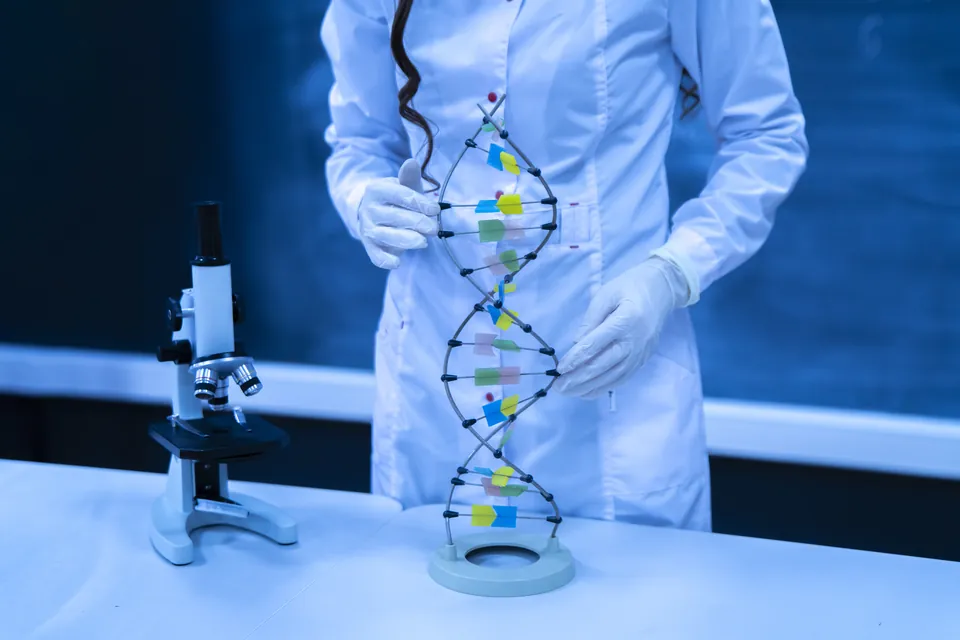
What is sperm DNA fragmentation, how does it differ from a semen analysis and when is it considered? How guidelines differ and the limits of the test.
Sperm DNA fragmentation refers to breaks and damage that occur in the genetic material (DNA) carried by the sperm, and there is a special test aimed at measuring the level of this damage. The test is not a routine investigation; sources also take different approaches on who benefits from it. For this reason the subject cannot be summed up as either "must definitely be done" or "unnecessary". The information below offers a general framework and does not replace a doctor's assessment of your own situation.
What is sperm DNA fragmentation?
Every sperm cell carries the genetic information that will be passed to the embryo with fertilisation. This information lies in the DNA, which is in the form of a chain; the presence of breaks or damage in the chain is called "fragmentation". It is thought that production processes inside the cell and outside factors may play a part in the occurrence of the damage, but in an individual the cause often cannot be determined.
The level of fragmentation is a measure showing to what extent cells carrying this damage are present in the sperm sample. The result is not a diagnosis, but additional information that the doctor reads together with the other findings.
How does it differ from a spermiogram?
A standard semen analysis (spermiogram) looks at sperm count, movement and shape; it does not assess DNA integrity. Sperm DNA fragmentation is a separate test and is not part of the standard analysis. The outwardly visible characteristics of the sperm and the state of the genetic material inside it do not tell the same thing; for this reason the two tests cannot be used in place of one another.
In a man who has no sperm at all in the ejaculate, this test cannot be applied on the sample.
The fluorescence in situ hybridisation (FISH) test, which examines the number and structure of the chromosomes of sperm cells, is also a separate laboratory examination. FISH assesses not the breaks in the DNA chain but the numerical or structural state of the chromosomes; for this reason it does not take the place of the sperm DNA fragmentation test and seeks the answer to a different question. The doctor decides which test is appropriate to request.
For whom may the test be considered?
According to current guidelines, this test is considered in three situations: couples who have had recurrent pregnancy loss after natural conception, couples who have experienced failure in assisted reproduction treatment, and men with unexplained infertility. This list is not an obligation; it shows the contexts in which the test can be considered. Routine testing with tests that measure reactive oxygen species is not recommended.
Outside these three situations, the doctor, looking at the history and the other test results, decides whether the test is necessary.
Why do guidelines assess the test differently?
Guidelines do not meet at the same point on the place of this test. Some guidelines recommend the test in the particular situations listed above. Other guidelines do not recommend the routine use of this test in couples whose semen analysis is normal; there are also assessments that do not recommend the routine use of advanced sperm function tests in general. Part of this difference stems from which group the recommendations are aimed at: one addresses men with unexplained infertility, the other couples whose semen is normal.
The evidence is limited; for this reason the decision is not made the same for everyone, and is taken individually together with the doctor.
How is the test result interpreted, and what are its limits?
There is more than one laboratory method for measuring sperm DNA damage; TUNEL is one of them and is based on marking and detecting breaks in the DNA chain. Because the methods measure different things, the result obtained with one method cannot be compared with the result of another. The laboratory and the doctor decide together which method will be used. Agreement is also limited on the threshold values to be used in interpretation. For this reason, in assessing the result it matters by which method and in which laboratory the test was done.
Another limit is that the result does not prove a cause-and-effect relationship. A high value does not show that the finding on its own is the factor preventing pregnancy.
Can lifestyle and varicocele affect the result?
Current guidelines accept that varicocele may be linked to sperm DNA damage. It is known that obesity, inactivity, smoking and excessive alcohol can adversely affect sperm quality, and change in these areas is recommended. These recommendations are aimed at general sperm quality; one should be cautious about promised results that they will lower DNA fragmentation.
What can be done if the result is high?
What the result will be used for depends on which problem is being pursued. In unexplained infertility or after failure of assisted reproduction treatment, the doctor looks at whether there is a correctable factor such as varicocele. In men with unexplained infertility and high sperm DNA damage, or after failure of assisted reproduction treatment, surgical treatment of varicocele may be considered; this recommendation is weak and does not cover every man with a varicocele.
If assisted reproduction treatment is planned, in some situations the doctor may discuss using sperm obtained from the testis instead of the ejaculate. The evidence on the benefit of this option is limited, and this decision is made together with the doctor only after all the findings have been assessed together.
If the woman's age is advancing, time spent pursuing additional tests can lengthen the couple's overall process; for this reason the decision on whether the test will be done is considered together with the couple's situation and time frame. Do not start or stop hormones, supplements or any other medicine on your own decision.
Frequently Asked Questions
Is any special preparation needed before the test?
The sample is prepared and delivered according to the guidance given by the laboratory; for the period and details, your own laboratory's instructions are the basis.
Do antioxidant supplements lower DNA damage?
In a placebo-controlled study, antioxidants were not seen to bring an improvement in semen parameters and DNA integrity compared with placebo. You should consult your doctor before using supplements and herbal products.
Which doctor should I discuss the test result with?
The doctor who requested the test or a urology specialist can interpret the result. Bringing the report, your previous semen analyses, your history of any previous pregnancy loss or assisted reproduction treatment and the list of medicines you use to the appointment makes the assessment easier. Whether the test will be done is decided with this information together.
If my spermiogram is normal, is the DNA integrity normal too?
No. A spermiogram assesses sperm count, movement and shape; it does not show DNA integrity. However, a normal spermiogram does not mean that the DNA fragmentation test needs to be done routinely either.
Should the sperm DNA fragmentation test be done for everyone?
No. The test is not a routine investigation. It may be considered in situations such as recurrent pregnancy loss, failure of assisted reproduction treatment and unexplained infertility; because the approach of guidelines differs, the decision is made together with your history and your other findings.
If my result is high, is the reason pregnancy has not happened settled?
No. A high value alone does not show a cause-and-effect relationship. Your doctor interprets the result together with your other findings.
Can I compare tests done with different laboratory methods?
No. The methods measure different things, and agreement on interpretation thresholds is limited. It should be taken into account by which method and in which laboratory the result was obtained.
Do FISH and TUNEL examine the same thing?
No. FISH assesses the numerical or structural state of the chromosomes. TUNEL, on the other hand, is one of the methods that detect breaks in the DNA chain. Your doctor decides which examination is appropriate.
Can this test be done on a sample with no sperm at all?
No. If there is no sperm in the ejaculate, the sperm DNA fragmentation test cannot be applied on the sample.
Is varicocele treatment always necessary when DNA damage is high?
No. It may be considered in particular situations such as unexplained infertility with high DNA damage, or failure of assisted reproduction treatment. The recommendation is weak and does not cover every man with a varicocele.
Does using sperm from the testis definitely bring benefit when the result is high?
No. In some situations this option may be discussed with your doctor; the evidence on its benefit is limited. The decision is made together with all your findings.
Do lifestyle changes definitely reduce DNA damage?
Such a result cannot be promised. Adjustments related to weight, activity, smoking and excessive alcohol are aimed at general sperm quality; one should be cautious about practices said to lower DNA fragmentation.
Get Your Free Consultation
Fill out the form below and our team will contact you

