


What is IVF treatment, who is it recommended for, what are its stages, risks and the factors that affect success? Learn the general framework.
IVF treatment (in vitro fertilisation) is an assisted reproduction treatment in which the egg is fertilised outside the body in a laboratory and the resulting embryo is placed in the uterus. IVF is not the first step for every couple; whether it will be recommended for you is determined according to your age, the cause of the infertility and the result of previous treatments. Here you will find a general guide for couples considering IVF: you can read what IVF is, in whom it is considered, the general flow of the process, the risks and the factors that affect success. The details of the procedures are covered under separate topic headings. The information below is not a diagnosis or treatment recommendation specific to you; the decision is made according to the assessment you carry out together with your doctor.
What is IVF, and how is it done?
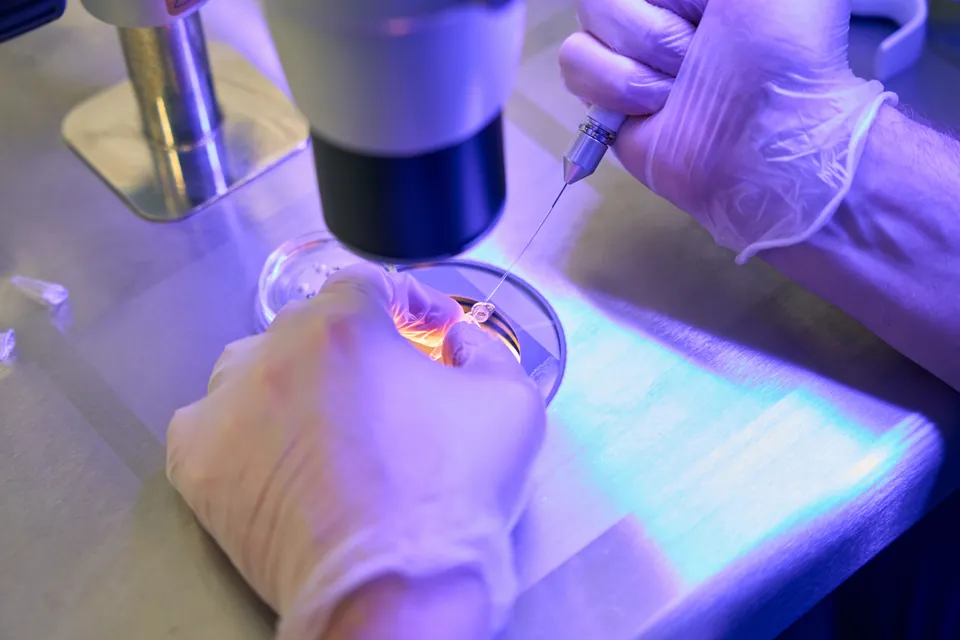
In IVF your ovaries are stimulated with medicines, your matured eggs are collected with a fine needle and brought together with sperm in the laboratory. The fertilised eggs are monitored as embryos for a few days; the embryo considered suitable is transferred to your uterus. If surplus embryos form, they can be frozen and stored with your and your partner's consent.
What is the difference between IVF, microinjection and insemination?
These three terms are often confused. Insemination (IUI) is the placing of prepared sperm into the uterus at the time of ovulation; fertilisation takes place inside the body. In classic IVF the egg and sperm are brought together in a dish in the laboratory and fertilisation happens by itself. In microinjection (ICSI), a single sperm is placed directly inside the egg. Not every IVF treatment means microinjection. Microinjection makes particular sense where there is a male factor; its routine use in couples without a male factor has not been shown to bring an additional benefit in terms of live birth.
At which step of infertility treatment does IVF come?
Infertility treatment often proceeds in steps: assessment, lifestyle adjustments if needed, ovulation support and insemination, and then IVF. But this order is not applied to everyone. If your fallopian tubes are blocked, if the male factor is marked or if your age is advanced, a move to IVF can be made earlier. At which step to start and how long it is reasonable to wait are determined by your doctor according to your age and history. Current guidelines on this subject also emphasise that the treatment path differs according to the cause and age.
Who is IVF recommended for?
IVF is not the treatment of a single disease; it is a method used for different causes. The main situations are as follows:
- Tubal factor: The fallopian tubes being blocked or damaged. If there is a collection of fluid in the tube (hydrosalpinx), this may need to be dealt with separately before IVF.
- Male factor: Problems related to sperm count, movement or structure. Infertility is not a condition of the woman alone; both partners of the couple are assessed equally.
- Unexplained infertility: Couples in whom no cause can be found on standard investigations and for whom simpler treatments have not worked.
- Endometriosis and ovulation disorders: IVF may be considered when first-step treatments have not worked.
- The woman's age and ovarian reserve: As age advances, time becomes more decisive in the choice of treatment.
This list is not a decision table. The same cause may require different paths in two different couples; the approach that suits you is determined by your doctor assessing your examination and test results as a whole.
What assessments are made before starting treatment?
You and your partner need to be assessed before treatment. Tests that include ovarian reserve and the state of the uterus and tubes in you, and semen analysis in your partner, are part of this stage. The aim is to choose the right method for you without prolonging treatment unnecessarily. Which tests are needed varies from person to person.
How does the IVF process proceed?
Although the process differs according to the centre and the person, the general flow is similar. IVF treatment is carried out within Ota Jinemed and Liv Hospital Ulus, with the laboratory and embryology teams of these hospitals.
How are ovarian stimulation and monitoring carried out?
Hormone medicines, usually as injections, are used so that several eggs develop together. During this period you are monitored with blood tests and ultrasound; the dose and duration of the medicine can be adjusted according to your response. The stimulation regimen is chosen according to your age, your ovarian reserve and your previous response.
How are the trigger and egg collection performed?
When your eggs have developed sufficiently, a trigger is given to complete their maturation. Egg collection is performed through the vagina under ultrasound guidance, usually under sedation or anaesthesia.
How do fertilisation and embryo development take place in the laboratory?
The eggs collected from you are brought together with sperm. Fertilisation is checked and the embryos are monitored for a few days. Not every egg collected is expected to fertilise, nor every embryo to develop; losses at this stage are a natural part of the process.
Is the embryo transfer fresh or frozen?
The embryo is placed in your uterus with a thin catheter. The transfer can be done in the same cycle (fresh), or at a more suitable time after your embryos have been frozen (frozen). Which is chosen is decided by your doctor according to factors such as your hormone level, the risk of overstimulation and the conditions of your uterus. The number of embryos to be transferred is also part of this plan: guidelines on this subject recommend single embryo transfer, regardless of age, to reduce the risk of multiple pregnancy. The number to be applied in Turkey is determined according to current legislation and your doctor's assessment.
What do support after the transfer and the pregnancy test involve?
After the transfer, medicine is mostly used to support the lining of your uterus. Your pregnancy test is done as a blood test on the day your doctor specifies; home tests done early can be misleading. After a positive result, the location and development of your pregnancy are monitored with the first ultrasound.
What determines the chance of success in IVF?
The result of treatment does not depend on a single factor. The main elements that affect success are as follows:
- The woman's age: Regarded as the factor that affects the outcome most strongly; the chance decreases as age advances.
- Ovarian reserve and response to stimulation: The number and quality of eggs collected affect the course of treatment.
- Sperm quality and embryo quality: They affect fertilisation and embryo development.
- Uterine factor: Problems affecting the inner surface of the uterus (such as polyps, adhesions and fibroids) can affect implantation.
- Lifestyle: Factors such as smoking and being very overweight or underweight can affect the outcome adversely.
How should success rates be read?
There is not a single answer to the question "what percentage?" in IVF. Success varies with age; rates differ according to the source and the denominator. One source may base itself on live birth per transfer, another on clinical pregnancy per egg collection, and another on the whole attempt. Countries, years and patient groups also differ; preliminary data in national registries may change later. For this reason the figures from different sources cannot be compared directly with one another. We do not give an average rate for Turkey. It is more meaningful to talk with your doctor about the expectation in your own situation, according to your age and diagnosis. The factors that affect success and the level of evidence are explained in more detail on a separate page.
Are add-on procedures necessary for every couple?
There are some procedures recommended in addition to IVF treatment: uninterrupted monitoring of the embryo, assisted hatching, tests and procedures aimed at the lining of the uterus, genetic screening, and immune-related tests and medicines. Current recommendations on this subject do not recommend the routine use of most of these procedures; there are many practices for which high-quality data are lacking. There are a few exceptions that may be useful in particular conditions, but you should make this decision not on the assumption that an add-on "definitely increases the chance", but by talking with your doctor according to your situation and the level of data. It is your right to ask why an add-on is being recommended, what data it rests on and its additional cost.
What are the risks and side effects in IVF?
IVF is a treatment involving medicines and a procedure; risks are not seen in the same way in everyone. The main risks are medicine side effects, ovarian hyperstimulation syndrome (OHSS), multiple pregnancy and complications that can rarely be seen during the procedure.
What are the medicine side effects?
Bloating of the abdomen, headache, mood changes and a reaction at the injection site can be seen due to hormone medicines.
What is ovarian hyperstimulation syndrome (OHSS), and when should you seek care?
OHSS is a condition that can arise when your ovaries respond excessively to stimulation. A high egg response, young age, low body weight and polycystic ovary syndrome are linked with the risk. If you experience rapid weight gain, marked swelling and pain of the abdomen, nausea and vomiting, a decrease in the amount of urine, shortness of breath, or swelling and pain in the leg, you should go to a healthcare facility without waiting. Strategies aimed at reducing the risk (such as the choice of protocol, the trigger method and freezing the embryos) are included in current guidelines; which one is applied is your doctor's decision.
Why is the risk of multiple pregnancy important?
When more than one embryo is transferred, the likelihood of a pregnancy with twins or more babies increases; this raises risks such as preterm birth for you and your babies. Single embryo transfer is recommended for this reason.
Is there a risk after egg collection, and of ectopic pregnancy?
After egg collection, bleeding, infection or injury to neighbouring organs can be seen, although rarely. Pregnancies that occur with IVF can also be ectopic pregnancies.
Within what legal framework is IVF carried out in Turkey?
In Turkey, assisted reproductive treatment is carried out within the relevant regulation of the Ministry of Health. The regulation provides that treatment is defined for married couples considered medically suitable, that applicants complete a joint informed consent form, and that storing embryos is subject to certain conditions and periods. Because the details and exceptions of this framework can change over time, current legislation and your doctor's guidance are the basis for questions about your own situation.
The Social Security Institution contributes to IVF treatment under certain conditions. Requirements such as age, marriage and contribution conditions, and the number of attempts, may be updated over time; the situation on the date of publication may have changed. For current conditions, you should look at the official announcements of the Social Security Institution and obtain confirmation before the procedure through your doctor or the contracted centre.
What happens if IVF is unsuccessful?
An attempt that does not succeed is a difficult experience for you; feeling sadness, anxiety and tiredness during this process is usual, and it is appropriate to ask for support. From a medical point of view, the next step is to review the results of the attempt together with your doctor: the response to stimulation, fertilisation, embryo development and the conditions of the transfer are assessed. After this assessment, a change of protocol, an additional test or a different approach may be considered. Repeated failure requires a separate assessment.
Frequently Asked Questions
Is IVF the first option for everyone?
No. For many couples the first step is assessment and simpler treatments. In situations such as a blocked tube, a marked male factor or advanced age, a move to IVF can be made earlier. The path is determined according to the cause and age.
Is microinjection necessary in every IVF treatment?
No. Microinjection makes particular sense where there is a male factor. Its routine use in couples without a male factor has not been shown to bring an additional benefit in terms of live birth.
Does every egg collected fertilise, and does every embryo develop?
No. Not every egg collected is expected to fertilise, nor every embryo to develop; losses at this stage are a natural part of the IVF process.
What happens if surplus embryos form?
If surplus embryos form, they can be frozen and stored with your and your partner's consent.
Should I do the pregnancy test at home?
No. Home tests done early can be misleading. Your pregnancy test is done as a blood test on the day your doctor specifies.
Is there a single success rate in IVF?
No. Success varies with age; rates differ according to the source and the denominator (different measures may be used, such as live birth per transfer or clinical pregnancy per egg collection). For this reason the figures from different sources cannot be compared directly with one another.
Do add-on procedures increase the chance of success?
For most of them, this has not been shown by data. Current recommendations on this subject do not recommend the routine use of many add-on procedures. You can ask your doctor whether a procedure is necessary for you and what data it rests on.
Do you need to be married for IVF in Turkey?
The assisted reproductive treatment regulation defines the practice for married couples considered medically suitable. Questions about your own situation need to be clarified according to current legislation and your doctor's guidance.
Does the Social Security Institution contribute to IVF treatment?
Yes, the Social Security Institution contributes under certain conditions. Because requirements such as age, marriage, contributions and the number of attempts may be updated over time, you should obtain confirmation from the official announcements of the Social Security Institution and from your doctor before the procedure.
How is the risk of multiple pregnancy reduced?
The number of embryos transferred is one of the most important factors that determine the risk. Current guidelines on this subject recommend single embryo transfer regardless of age; with the transfer of two embryos, the risk of multiple pregnancy and preterm birth increases. You decide the number to be transferred together with your doctor.
If an attempt is unsuccessful, is a new attempt planned straight away?
No. First the results of the attempt are reviewed together with your doctor: the response to stimulation, fertilisation, embryo development and the conditions of the transfer are assessed. According to this assessment, a change of protocol, an additional test or a different approach may be considered.
Get Your Free Consultation
Fill out the form below and our team will contact you

