


What is microinjection (ICSI), when is it recommended and how does it differ from conventional IVF? Evidence, risks and genetic counselling.
Microinjection (ICSI) is a method used in IVF treatment in which fertilisation is achieved in the laboratory by selecting a single sperm cell and placing it inside the egg. ICSI is not needed in every IVF treatment; whether it is needed for you is mostly determined by the cause of the infertility and the results of your previous cycles. Below you will find a general framework; this information does not replace a diagnosis or treatment recommendation specific to you.
What is microinjection (ICSI)?
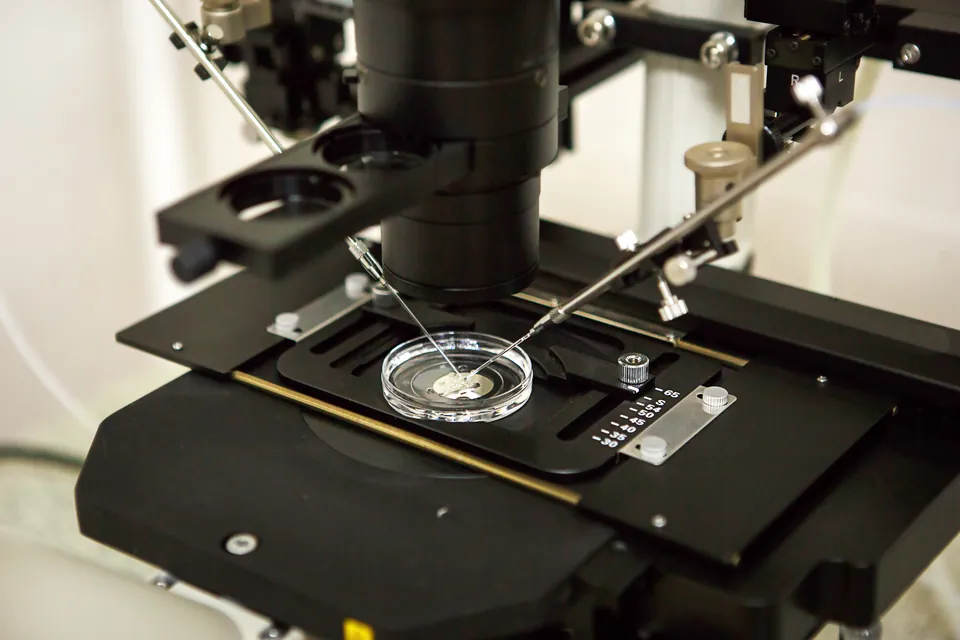
ICSI is a fertilisation method applied in the laboratory after your eggs have been collected. The embryologist takes a sperm cell with a fine instrument under the microscope and places it inside the egg cell. The sperm does not have to enter the egg by itself. If fertilisation occurs, the resulting embryo is monitored for a few days and, if considered suitable, transferred to your uterus.
How does fertilisation differ in conventional IVF?
In conventional IVF your eggs and the prepared sperm are brought together in the same dish; the sperm entering the egg and fertilisation happen by themselves. In both methods, ovarian stimulation, egg collection and embryo transfer are the same. The difference is only in how fertilisation is achieved; for this reason, the decision about ICSI rests less on the treatment as a whole than on the question of which method is suitable at the fertilisation stage.
In which situations is ICSI recommended for you?
- If the sperm count, movement or structure is markedly impaired (severe male factor), fertilisation can become difficult with the conventional method. This is accepted as a classic indication for ICSI. Which sperm abnormality requires ICSI is decided by your doctor, assessing your semen analysis results and your history together.
- If there was no fertilisation or very little in a previous cycle done with the conventional method, ICSI may be recommended by your doctor in the next cycle.
- ICSI may also be preferred if sperm obtained by surgical methods will be used and in cycles where genetic testing will be done on the embryos.
Although current recommendations on this subject do not recommend the routine use of ICSI in infertility without a male factor, they accept that it may be appropriate in certain situations. For each of these situations the decision is made according to the picture of you and your partner.
Is ICSI necessary for every couple?
No. Current recommendations on this subject do not recommend the routine use of ICSI in infertility without a male factor; no benefit has been shown in terms of live birth, whereas the laboratory procedure and the cost increase. In unexplained infertility, when there has been no result from stimulated insemination and a move to IVF is made, conventional IVF is recommended over the ICSI method; this recommendation is classified as a strong recommendation, but the reliability of the data it rests on is low.
For this reason, generalisations such as "ICSI is safer" or "ICSI definitely increases the chance" are not supported by evidence. Your success is affected most by your age and embryo quality; these are independent of the fertilisation method. If ICSI has been recommended while your sperm result is normal, it is sensible to ask your doctor the reason.
ICSI is mostly considered because of a problem on the male side; even so, treatment stages such as the use of medicines, monitoring and egg collection are carried out on you.
What are the risks and cautions of ICSI?
During ICSI the egg can be damaged or fertilisation may not occur; fertilisation of every egg treated cannot be guaranteed. Apart from this, the general risks of IVF, that is, medicine side effects, ovarian hyperstimulation syndrome (OHSS), multiple pregnancy, procedure risks related to egg collection and embryo transfer, and ectopic pregnancy, also apply to ICSI.
Is there a health risk for children born through ICSI?
Nothing definite can be said. In some observational studies, an increase has been reported in congenital anomalies and in some changes affecting gene expression in children born through ICSI. However, in these data it is not possible to distinguish whether the cause is the method itself, the underlying infertility, or other factors such as multiple pregnancy. Consequently, it can be said neither that it is "harmless" nor that it is "harmful"; the information is limited and based on observation. You can talk to your doctor about your concerns before the decision.
When is genetic counselling considered?
Some genetic causes can be found, particularly in men with severe sperm abnormalities. With ICSI there is a possibility that such a problem may in some cases be passed on to a male child. For this reason, in severe male factor, genetic investigation and genetic counselling are considered; your doctor decides which investigations are needed.
How does the process proceed after ICSI?
Your eggs that have fertilised are monitored in the laboratory; not every embryo is expected to develop. The embryo whose development is found suitable is transferred to your uterus, and freezing of the remainder can be discussed. The number to be transferred is determined according to legislation and your doctor's assessment. Current guidelines on this subject put single embryo transfer to the fore, also in cycles carried out with ICSI, to reduce the risk of multiple pregnancy.
IVF treatment is carried out within Ota Jinemed and Liv Hospital Ulus, with the laboratory and embryology teams of these hospitals.
Frequently Asked Questions
Does ICSI give healthier embryos?
No. ICSI is a method that serves to achieve fertilisation; it does not determine or improve the chromosomal structure or developmental potential of the embryo. Embryo quality depends on the characteristics of the egg and sperm and on your age, and is monitored separately. Information about the genetic structure of the embryo can be obtained only with a separate genetic test.
If the sperm count is low, is a genetic test always needed?
The need varies with the degree of the abnormality and your history. Where the sperm count is very low or no sperm are seen, investigations that look at the chromosomal structure and at certain regions of the Y chromosome are considered. The aim is to know in advance whether there is a problem that could be passed on to the child and to receive counselling accordingly. Your doctor decides which test is suitable for you.
Do all the eggs treated with ICSI fertilise, and what happens if none fertilise?
If there is no fertilisation at all, no embryo to be transferred forms in that cycle. In such a case, the cause has to be sought in the egg, the sperm or another factor; your doctor then decides, looking at this assessment, whether the method or the plan will be changed in the next cycle.
Is ICSI a completely different treatment from conventional IVF?
No. Ovarian stimulation, egg collection and embryo transfer are the same in both methods. The difference is only in how fertilisation is achieved in the laboratory.
Is ICSI a safer method, or one that increases the chance of success?
No. Generalisations such as "ICSI is safer" or "ICSI definitely increases the chance" are not supported by evidence. Success is affected most by your age and embryo quality; these are independent of the fertilisation method.
ICSI was recommended to me although my sperm result is normal. Is that normal?
The routine use of ICSI is not recommended in infertility without a male factor. If ICSI has been recommended while your sperm result is normal, it is sensible to ask your doctor the reason; the decision is made according to the picture of you and your partner.
Are ovarian stimulation or egg collection done differently in ICSI treatment?
No. In both methods ovarian stimulation, egg collection and embryo transfer are carried out in the same way; the difference is only in how fertilisation is achieved.
Even if ICSI is due to a male factor, does the treatment process concern only the man?
No. Although ICSI is mostly considered because of a problem on the male side, treatment stages such as the use of medicines, monitoring and egg collection are carried out on you.
How many embryos are transferred to the uterus after ICSI?
The number to be transferred is determined according to legislation and your doctor's assessment. Current guidelines put single embryo transfer to the fore, also in cycles carried out with ICSI, to reduce the risk of multiple pregnancy.
Where is ICSI treatment carried out?
IVF treatment is carried out within Ota Jinemed and Liv Hospital Ulus, with the laboratory and embryology teams of these hospitals.
Get Your Free Consultation
Fill out the form below and our team will contact you

