


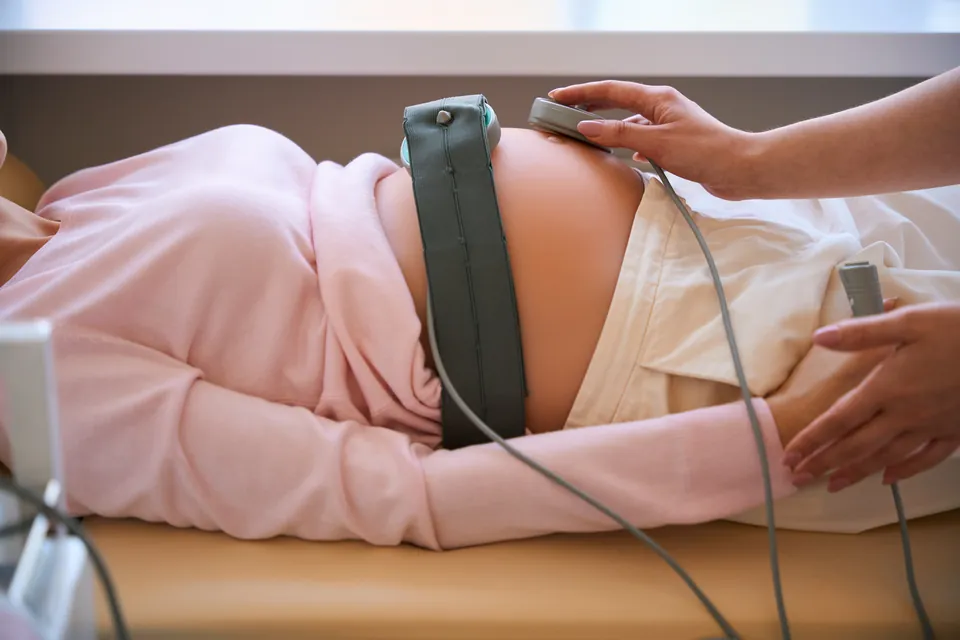
What is an NST (non-stress test), how is it done and for whom is it recommended? Reactive and non-reactive results, the test's limits and questions.
An NST (non-stress test) is a monitoring test, applied over the abdomen, that records how the baby's heartbeat changes with movements in pregnancy. The result is reported as "reactive" or "non-reactive". A non-reactive result does not on its own mean there is a problem; the baby may be asleep at the time, and the doctor generally requests additional monitoring. An NST is not done routinely in every pregnancy but in situations where the doctor thinks it necessary. When the test will start, how often it will be repeated and how long it will last are determined according to the person; the doctor who follows you or the institution performing the test will tell you these details.
What does an NST record, and why is it done?
An NST records the baby's heartbeat while the baby is moving or the uterus is contracting. The heartbeat of a healthy baby speeds up with movement; seeing this change on the recording is reassuring information about the baby's state at that moment. The test has no known risk.
The aim of antenatal fetal monitoring is defined as reducing the risk of stillbirth.
Is an NST done routinely in every pregnancy?
According to research done, there is no clear evidence that recordings of the baby's heartbeat during pregnancy, including NST, improve perinatal outcomes (those around the time of birth); the studies examined were done in high-risk pregnant women, were few in number and were found to be of low quality. For this reason, whether the test will be done is assessed by your doctor according to the person and the state of the pregnancy.
For whom can an NST be recommended?
The test can be recommended in situations such as the following:
- The baby moving less than usual
- The pregnancy going beyond the expected time
- Health problems such as high blood pressure, diabetes, heart disease or a clotting disorder
- A complication in an earlier pregnancy
- Rh incompatibility
- Multiple pregnancy
This list is not closed. Whether the test is necessary for you is decided by the doctor who knows your state of health; a situation appearing in the list does not mean the test will be done, just as a situation not in the list does not rule out the test.
What happens during an NST?
The test is generally done in a semi-reclining or lying position. Two bands are placed on your abdomen: one records the baby's heartbeat and the other the uterine contractions. When you feel the baby move, you press a button you are given; in this way the movement and the change in heartbeat can be assessed together. The health professional performing the test will tell you how long the recording will last.
Is preparation needed before an NST?
Generally no special preparation is needed. Even so, if you have been given an instruction about eating or taking medicines before the test, follow it. Tell your doctor about the medicines you use regularly; some medicines can affect the result.
What do reactive and non-reactive results mean?
A reactive result shows that the baby's heartbeat speeds up with movement as expected and is reassuring. A non-reactive result means that enough speeding up of the heartbeat was not seen during the recording or that the baby moved little. This may not show that there is a health problem: the baby may be asleep or some medicines may have affected the heartbeat. Instead of assessing the result by looking at comments on the internet, go over it with your doctor.
What can be done after a non-reactive result?
After a non-reactive recording, your doctor may request an additional test or monitoring; methods such as ultrasound can be used as an additional assessment. If the pregnancy is sufficiently advanced, monitoring or treatment may be needed. Your doctor determines the next step by assessing the recording and your state of health together.
What are the limits of an NST result?
An NST is a recording of the heartbeat at a particular moment. A reactive result is not an assurance against situations that may arise in the following days. A single test result does not tell the whole picture; the doctor interprets the result together with your baby's movements and your state of health. Even if your test result is good, if you later notice a change in the baby's movements, do not brush it aside by saying "my result was normal".
If the baby's movements change, should you wait for your NST appointment?
When you notice a decrease or change in your baby's movements, you need to seek care from a health professional without delay. There is no particular "normal" number of movements. Having an NST appointment ahead of you is not a reason to postpone seeking care. In late pregnancy, on these visits the baby's heartbeat is monitored and, if necessary, an ultrasound is done; these checks most often end with a reassuring result.
What can you ask your doctor before the test?
- Ask why this test is recommended for you and whether it will be repeated during pregnancy.
- Find out whether the medicines you use could affect the recording result.
- Ask whether there is any instruction for the test day about eating or anything else.
- Find out what the next step will be if it comes out non-reactive and how the result will be communicated to you.
- Ask where and by what route to seek care if there is a change in the baby's movements.
Frequently Asked Questions
Does a baby heart-listening device at home take the place of an NST?
Home-type heartbeat-listening devices should not be relied on. Even if you use such a device, you need to go to a healthcare facility when you notice a change in the baby's movements.
What is done if the baby does not move during the test?
A baby that looks still may be asleep. A device that makes a sound can be used to wake the baby, or you may be asked to eat a snack or drink something sweet. The health professional performing the test decides which of these methods is suitable for you.
Are NST and CTG the same thing?
The terms are used in different ways in sources. Some sources deal with heartbeat recordings that include NST under the name "antenatal cardiotocography" (CTG), while others do not use this term. You can ask your doctor which name is used in your report and what it means.
Are NST and ultrasound the same thing?
No. An NST is the recording of the heartbeat and uterine contractions with bands placed on the abdomen; ultrasound is an imaging method. The two give different information; the doctor may plan one or both according to your situation.
Does a non-reactive result show that there is definitely a problem in my baby?
No. The baby may be asleep or medicines may have affected the heartbeat. Your doctor may plan an additional test or monitoring by assessing the recording and your state of health together.
Does a reactive result give assurance for the following days too?
No. An NST is a recording at a particular moment. It does not rule out situations that may arise in the following days; a single test does not tell the whole picture.
If my baby's movements change, should I wait for my NST appointment?
No. Tell a health professional about a decrease or change without delay. A planned NST is not a reason to postpone seeking care.
Is there a particular number of movements regarded as normal for the baby?
No. A decrease or change in your baby's usual movements is what matters. You should seek care from a health professional in the event of such a change.
Is an NST done with the same frequency in every pregnancy?
No. Your doctor determines the necessity of the test, its timing, its repeat frequency and its duration according to the state of the pregnancy.
Should I tell them about my medicines before an NST?
Yes. Some medicines can affect the result. You should follow the preparation instructions given about eating or taking medicines.
Can an ultrasound be requested after a non-reactive result?
Yes. Additional assessments such as ultrasound can be used. The next step is determined by considering your recording and your state of health together.
If I have one of the listed risk conditions, is an NST definitely done?
No. The list contains example situations; it does not decide on its own. A situation not in the list does not rule out the test being necessary either. The decision is made by the doctor who knows your state of health.
Get Your Free Consultation
Fill out the form below and our team will contact you

